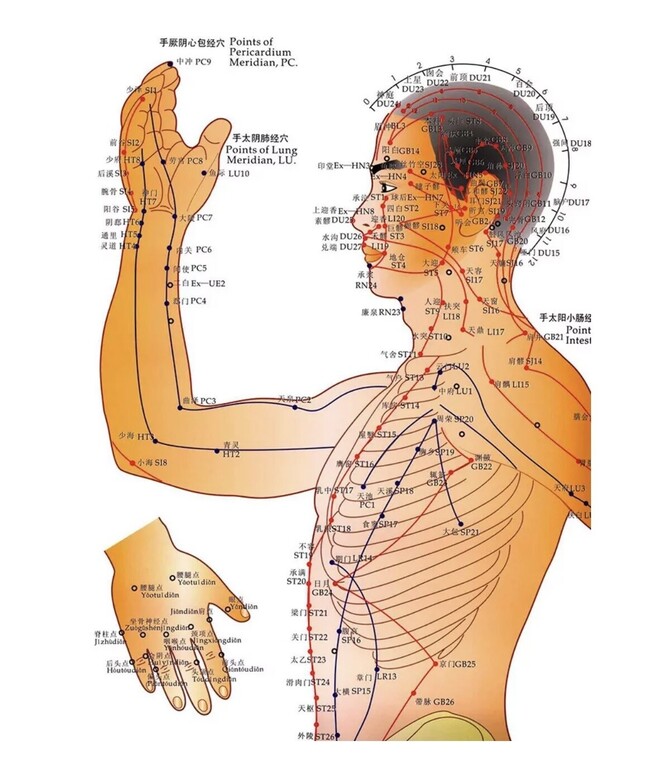
If you've ever had acupuncture treatment, you've likely heard the term meridian system. While the concept originates from Traditional Chinese Medicine (TCM), many people are surprised to learn how relevant it remains when discussing health, pain, stress, and overall wellbeing today.
The meridian system is a network of pathways that connects the body's organs, muscles, connective tissue, nervous system, and circulation. In Traditional Chinese Medicine, these pathways are believed to carry qi (vital energy) and blood throughout the body, helping maintain balance and healthy function.
When the flow of qi and blood becomes disrupted—whether from stress, injury, illness, poor sleep, emotional strain, or lifestyle factors—symptoms may develop. Acupuncture works by stimulating specific points along these pathways to help restore balance, improve circulation, and support the body's natural healing processes.
What Are Meridians?
Think of the meridian system as a communication network that links different parts of the body together. Rather than viewing organs and symptoms in isolation, Traditional Chinese Medicine sees the body as an interconnected system where everything influences everything else.
There are 12 primary meridians, each associated with a specific organ system and one of the Five Elements. These channels travel throughout the body and are used to understand patterns of health and disease.
While modern science has not identified physical structures that perfectly correspond to the classical meridian maps, research continues to explore the relationship between acupuncture points, connective tissue planes, the nervous system, circulation, and fascial networks. Many practitioners today view meridians as a functional model that helps explain the body's interconnected nature and guides effective treatment.
The Five Elements and the Meridian System
Traditional Chinese Medicine organizes the meridians into five elemental systems: Wood, Fire, Earth, Metal, and Water. These elements are not literal substances but rather ways of describing relationships and patterns within the body.
Wood
Liver and Gallbladder Meridians
Wood is associated with growth, flexibility, movement, and the smooth flow of qi throughout the body. Imbalances may contribute to stress, irritability, headaches, muscle tension, or menstrual concerns.
Fire
Heart, Small Intestine, Pericardium, and San Jiao (Triple Burner) Meridians
Fire relates to circulation, warmth, communication, emotional wellbeing, and mental clarity. It is closely connected to sleep, mood, and the nervous system.
Earth
Stomach and Spleen Meridians
Earth governs digestion, nourishment, energy production, and the body's ability to transform food into qi and blood. These meridians play an important role in energy levels, digestion, and overall vitality.
Metal
Lung and Large Intestine Meridians
Metal is associated with respiration, immunity, boundaries, and the body's ability to take in what is beneficial and release what is no longer needed.
Water
Kidney and Bladder Meridians
Water represents the body's foundational reserves, growth, development, reproduction, and healthy aging. These meridians are often involved in fertility, hormonal health, menopause, recovery, and resilience.
The Twelve Primary Meridians
Lung Meridian
Supports breathing, immunity, and the distribution of qi throughout the body.
Large Intestine Meridian
Associated with elimination and the body's ability to release waste and maintain balance.
Stomach Meridian
Responsible for receiving and breaking down food to provide nourishment and energy.
Spleen Meridian
Transforms food into qi and blood and supports healthy digestion and circulation.
Heart Meridian
Governs blood circulation and houses the Shen, which relates to mental, emotional, and spiritual wellbeing.
Small Intestine Meridian
Helps separate what is useful from what is not, both physically and energetically.
Bladder Meridian
Regulates fluid metabolism and has extensive connections throughout the back, neck, and nervous system.
Kidney Meridian
Stores Jing (Essence) and supports growth, reproduction, fertility, development, and healthy aging.
Pericardium Meridian
Protects the Heart and helps regulate emotional balance and circulation.
San Jiao (Triple Burner) Meridian
Coordinates communication and fluid movement between different regions of the body and supports overall regulation.
Gallbladder Meridian
Supports decision-making, stores and releases bile, and influences the health of muscles, tendons, and connective tissue.
Liver Meridian
Promotes the smooth flow of qi, supports healthy menstruation, and nourishes the tendons and nervous system.
How Acupuncture Uses the Meridian System
During your initial visit, your acupuncturist gathers information about your health history, symptoms, sleep, digestion, energy levels, stress, pain patterns, menstrual health, and lifestyle habits. These details help identify patterns of imbalance and determine which acupuncture points may be most beneficial.
Treatment involves placing very fine, sterile needles at carefully selected points along the meridians. Depending on your needs, treatment may also include cupping, dietary recommendations, lifestyle guidance, or Chinese herbal medicine.
Rather than focusing solely on a diagnosis or symptom, acupuncture seeks to understand the broader pattern contributing to your health concerns. This whole-person approach is one reason many people seek acupuncture for complex or chronic conditions.
A Modern Perspective on Acupuncture
Today, acupuncture is commonly used alongside conventional healthcare to support a wide range of concerns, including pain management, stress reduction, fertility support, pregnancy care, digestive health, headaches, sleep difficulties, and recovery from injury.
While Traditional Chinese Medicine uses the language of qi and meridians, modern research suggests acupuncture may influence the nervous system, circulation, connective tissue, inflammatory pathways, and the body's natural pain-relieving mechanisms.
These perspectives don't have to compete. For many practitioners and patients, they simply represent different ways of describing the same goal: helping the body function more effectively and return to balance.
Acupuncture at Alcove Acupuncture
At Alcove Acupuncture, treatment plans are tailored to your individual needs and health goals. Whether you're seeking support for pain, stress, fertility, pregnancy, postpartum recovery, hormonal health, digestion, sleep, or overall wellness, acupuncture offers a gentle, natural approach to care.
By combining the wisdom of Traditional Chinese Medicine with a modern understanding of health and healing, we can work together to support your body's innate ability to recover, regulate, and thrive.
Ready to experience acupuncture for yourself? Book your appointment today and discover how personalized treatment can help you feel your best.

Tessa Neilson
Contact Me