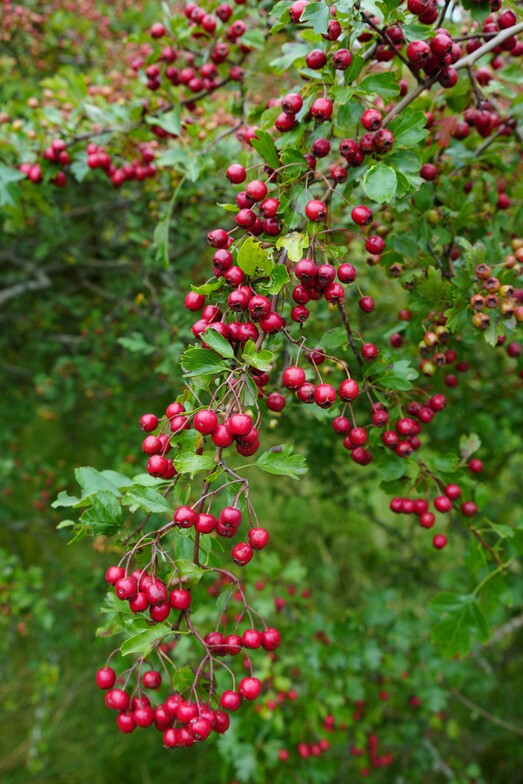
Herbal Medicine in Focus: the mighty Hawthorn tree, how it can soothe heartbreak
Some things take time to digest: a meal, a loss, the distance between what we hoped for and what we received.
Hawthorn holds an intriguing place where the heart, herbal medicine, and folklore meet. Its flowering branches, protective thorns, and bright red fruits have inspired generations of herbalists—and its uses span emotional ritual, cardiovascular support, and digestive medicine.
A personal connection to Hawthorn (Crataegus monogyna/laevigata)
When I studied with master herbalist Don Ollsin, he taught us to meditate beneath a hawthorn tree to free ourselves from heartbreak, longing, and yearning.
It is a practice that offers time to sit with what we feel. Beneath the branches, meditation becomes an opportunity to acknowledge loss, notice what we are holding, and make room for change.
Hawthorn belongs to the rose family, Rosaceae, alongside roses, apples, and pears. Like the rose, it pairs delicate blossoms with sharp protection. Its thorns offer a compelling image for the emotional heart: tenderness can coexist with boundaries.
Hawthorn in Medieval Folklore and Magic
In European folklore and folk magic, hawthorn is associated with love, protection, fertility, and the turning of the seasons. Known as the May tree, it has a longstanding connection with spring celebrations and renewal.
In contemporary magical practice, hawthorn is also used in rituals for tending a broken heart—honouring longing, grieving what has ended, and remaining open to love.
Meditating beneath the tree can be approached as a personal ritual: a place to give grief our attention and consider what we are ready to release.
Hawthorn in Western Herbal Medicine
In Western herbal medicine, hawthorn’s berries, leaves, and flowers are traditionally used as a cardiac tonic, supporting cardiovascular health. Its leaves and flowers also have a history of use for mild mental stress and nervous heart complaints.
Its reputation as a heart herb has prompted clinical research into standardized extracts, including their use alongside conventional treatment for chronic heart failure.
Several studies have reported benefits:
-
Tauchert, 2002: A randomized, placebo-controlled trial involving 209 patients with NYHA class III heart failure found improved maximum exercise workload with the higher-dose extract. Both doses studied reduced patient-reported heart-failure symptoms compared with placebo.
-
Degenring and colleagues, 2003: An eight-week trial involving 143 patients with NYHA class II heart failure found improved exercise tolerance with a standardized hawthorn berry extract. Participants receiving hawthorn achieved an exercise workload averaging 8.3 watts higher than those receiving placebo.
-
Cochrane review, 2008: This review included 14 trials, with 10 trials involving 855 participants contributing to pooled analyses. It found improvements in exercise tolerance, breathlessness, and fatigue, generally with hawthorn used alongside conventional treatment.
These findings concern specific standardized preparations and measured physical outcomes. They provide a research context for hawthorn’s traditional cardiac use; its role in heartbreak rituals belongs to its separate emotional and cultural history.
Shan Zha: Hawthorn in the Traditional Chinese Medicine Materia Medica
In Traditional Chinese Medicine, hawthorn fruit is known as Shan Zha 山楂. It is sour, sweet, and slightly warm, and enters the Spleen, Stomach, and Liver channels.
Its primary action is to resolve food stagnation, particularly following rich, fatty, or meat-heavy meals. It is traditionally used when retained food contributes to abdominal fullness, bloating, belching, and discomfort.
Shan Zha also moves Blood and disperses stasis, giving it a place in formulas addressing appropriate presentations of menstrual and abdominal pain.
The Chinese hawthorn fruit used as Shan Zha and the European hawthorn preparations commonly studied in Western herbal medicine come from related species within the genus Crataegus. Their plant parts, preparations, and traditional applications differ.
Hawthorn and the Gut Microbiome
Modern research is also exploring hawthorn’s relationship with the gut microbiome.
Hawthorn fruit contains pectin and other complex carbohydrates with prebiotic potential. Studies in mice have found that extracted hawthorn pectin can influence gut bacteria and improve aspects of lipid metabolism. Other experimental research has investigated its effects on the intestinal barrier.
These findings offer an interesting area of study alongside Shan Zha’s longstanding digestive use. They also highlight the importance of preparation: eating the fruit, drinking an infusion, and taking an extracted pectin preparation deliver different constituents in different amounts.
Digesting What We Have Experienced
Hawthorn’s digestive role offers a metaphor for heartbreak: processing what we have taken in, keeping what nourishes us, and allowing the rest to pass.
An experience can be over while our feelings continue. We may understand that something has ended and still feel longing—for the person, the possibility, or the future we imagined.
For me, the image of sitting beneath a hawthorn tree brings these themes together. Its roots hold it steady. Its blossoms open. Its thorns protect.
Sometimes longing remains even as we begin to let go. Hawthorn gives us an image for holding both.
References
-
Tauchert M. (2002). Efficacy and safety of crataegus extract WS 1442 in comparison with placebo in patients with chronic stable New York Heart Association class-III heart failure. American Heart Journal.
-
Degenring FH, Suter A, Weber M, Saller R. (2003). A randomised double blind placebo controlled clinical trial of a standardised extract of fresh Crataegus berries (Crataegisan) in the treatment of patients with congestive heart failure NYHA II. Phytomedicine, 10(5), 363–369.
-
Guo R, Pittler MH, Ernst E. (2008). Hawthorn extract for treating chronic heart failure. Cochrane Database of Systematic Reviews.
-
Effects of hawthorn pectin and its oligomers on gut microbiota and metabolites in high-fat diet mice. (2025). Food & Function.
-
Hawthorn pectin mitigates high-fat diet induced hyperlipidemia in mice through promoting Dubosiella newyorkensis. (2025). Carbohydrate Polymers.
Herbal treatment is individualized. People taking heart medication or receiving care for heart failure should discuss hawthorn with their prescribing clinician before adding it.

Tessa Neilson
Contact Me